Where Did Montessori Education Begin?
The method was created by Dr. Maria Montessori, an Italian physician and educator who was one of the first women to qualify as a doctor in Italy. In 1907 she opened her first school, the Casa dei Bambini (Children’s House), in a working-class neighborhood of Rome.
Montessori did not start with a theory. She started by watching. She noticed that young children were not happy to sit still and absorb information. They wanted to move, touch real objects, repeat activities until they were satisfied, and do things for themselves. Her classroom experiments, based on those observations, grew into a complete teaching method that spread across Europe, the United States, and Asia over the following decades. Today, training providers such as Nexora Montessori & Modern Skills Council carry this approach forward through Montessori teacher training and modern skills programs.
The Core Principles of the Montessori Method
A handful of ideas sit at the heart of the Montessori method. Understanding them makes everything else in the classroom make sense.
- Respect for the child. Children are treated as capable individuals with their own interests and pace, not as empty vessels to be filled with facts.
- The absorbent mind. Dr. Montessori believed that children under about six soak up language, habits, and culture almost effortlessly from their surroundings.
- Sensitive periods. Children pass through phases when they are especially ready to learn a particular skill, such as language, order, movement, or small details. Montessori teachers watch for these windows and offer the right activity at the right time.
- The prepared environment. The classroom is deliberately designed so that children can reach materials, move freely, and do things independently.
- Freedom within limits. Children choose what to work on, but within clear rules about respecting people, materials, and the shared space.
- Self-correcting materials. Many Montessori materials are designed so that the child can see their own mistake without an adult pointing it out, which builds confidence and problem-solving.
Montessori by Age: What Learning Looks Like at Each Stage
The Montessori approach divides childhood into broad stages, and the classroom changes to match each one.
Infants and toddlers (birth to about 3 years). The focus is on movement, language, and independence. Spaces are safe and low to the ground, and toddlers practice simple tasks like pouring water, feeding themselves, and putting away their belongings.
Early childhood (about 3 to 6 years). This is the classic Montessori classroom, often called “Children’s House.” Children explore practical life skills, sensory materials, early language, and early math through hands-on work.
Lower elementary (about 6 to 9 years). Children move from concrete materials toward abstract thinking. They ask big questions about history, nature, and the universe, and they often research and present topics in small groups.
Upper elementary (about 9 to 12 years). Work becomes more collaborative and in-depth, with longer projects, deeper research, and growing responsibility for their own learning.
Adolescents (about 12 to 18 years). Fewer schools offer a full adolescent program, but those that do focus on real-world work, community involvement, and preparing young people for adult life.
What Does a Montessori Classroom Look Like?
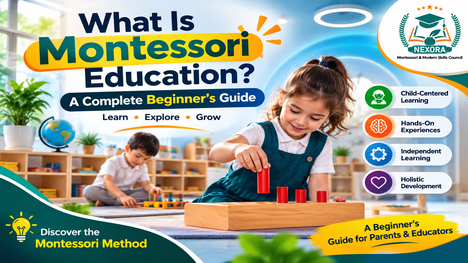
A typical Montessori education classroom looks quite different from a traditional one. There are no rows of desks facing a blackboard. Instead, you will see low, open shelves of learning materials, small tables, floor mats, plants, and children working alone or in small groups.
- Mixed-age groups. Children are usually grouped in three-year bands, such as 3 to 6 or 6 to 9. Younger children learn by watching older ones, and older children strengthen their own knowledge by helping.
- Long, uninterrupted work periods. Children are given extended blocks of time, often around three hours, to concentrate deeply on one activity without being interrupted by a bell.
- Hands-on materials. Items such as sandpaper letters, bead chains for counting, and pouring and buttoning exercises make abstract ideas concrete.
- Order and beauty. Materials are arranged neatly and kept complete. Each activity has a place, and children learn to return it there when they are done.
- The teacher as guide. Instead of lecturing, the teacher observes each child, introduces new materials at the right moment through short demonstrations, and then steps back.
The Five Main Areas of the Montessori Curriculum
In an early childhood classroom, learning is organized into five connected areas.
- Practical life. Everyday activities such as pouring, sweeping, folding, washing, and preparing food. These build coordination, concentration, and independence.
- Sensory. Materials that help children notice and compare size, shape, color, texture, and sound, building the foundation for later math and science.
- Language. Children learn sounds first, then letters, then writing and reading, using tools such as sandpaper letters and the movable alphabet.
- Mathematics. Concrete materials, such as golden bead material and number rods, let children physically handle quantities before moving to written numbers.
- Cultural studies. Geography, science, nature, music, and art help children understand the world and the people in it.
What Does a Typical Day Look Like?
Every school differs, but a typical morning in an early childhood classroom may look something like this:
- Arrival. Children hang up their belongings, greet the teacher, and settle in.
- Work cycle. For roughly three hours, children choose activities, work alone or with a friend, and return materials to the shelf. The teacher gives short individual or small-group lessons.
- Group time. The class may come together for a song, story, or discussion.
- Outdoor play and lunch. Children spend time outside and often help set the table and clean up.
- Afternoon. Depending on the school, the afternoon may include quieter activities, extended work, or rest for younger children.
Montessori Education vs. Traditional Schooling
| Feature | Montessori | Traditional |
| Who directs learning | Child chooses activities within limits | Teacher sets the lesson for everyone |
| Pace | Individual | Class-wide |
| Grouping | Mixed ages | Same-age classes |
| Teacher’s role | Guide and observer | Instructor |
| Materials | Hands-on, self-correcting | Mostly textbooks and worksheets |
| Schedule | Long, uninterrupted work periods | Shorter, timed lessons |
| Assessment | Mainly observation and portfolios | Mainly tests and grades |
Neither approach is automatically better for every child. The right fit depends on your child’s temperament, your family’s values, and the quality of the specific school.
Benefits of the Montessori Method
Parents who choose Montessori education usually cite a few key benefits.
- Independence. Children learn to dress themselves, prepare snacks, tidy up, and solve small problems on their own.
- Concentration. Long work periods help children build the ability to focus on a task from start to finish.
- Intrinsic motivation. Because children choose their work, they tend to learn out of curiosity rather than for rewards or grades.
- Social skills. Mixed-age classrooms encourage cooperation, patience, empathy, and leadership.
- Confidence. Self-correcting materials let children discover and fix their own mistakes, which builds resilience.
- Love of learning. Children are encouraged to follow their interests, which often makes learning feel enjoyable rather than forced.
At Nexora, we combine this hands-on, child-centered approach with modern skills such as digital literacy, design thinking, and collaboration. You can learn more about who we are and what we believe on our About page.
Research on outcomes exists but is mixed, and results depend heavily on how faithfully a school follows the method. Treat any claim of guaranteed results with caution.
Common Myths About the Montessori Method
“Children do whatever they want.” Not quite. Children choose from activities the teacher has prepared and shown them, and they are expected to respect the rules of the classroom.
“There is no structure.” The structure is built into the environment, the routines, and the sequence of materials rather than a rigid timetable.
“It is only for preschoolers.” Montessori programs exist from infancy through adolescence, though early childhood programs are the most common.
“Children can’t adjust to regular school later.” Many children adapt well, though some need time to adjust to a more teacher-led, test-focused setting.
“It does not teach academics.” Montessori children learn reading, writing, math, science, and geography, usually through hands-on materials before moving to abstract work.
Possible Drawbacks to Consider
- Quality varies. “Montessori” is not a protected trademark, so any school can use the name. Some follow the method closely and others only loosely.
- Cost. Trained teachers and specialized materials can make tuition higher than at nearby schools.
- Transition. Children moving to a very structured, exam-driven school may need time to adjust.
- Less suited to some temperaments. Some children thrive on more teacher-led structure and clear external deadlines.
- Limited options for older ages. Elementary and adolescent programs are less widely available than early childhood programs.
How to Choose an Authentic Montessori School
- Check teacher training. Look for teachers with recognized Montessori credentials, for example from AMI (Association Montessori Internationale) or AMS (American Montessori Society).
- Visit during work time. Children should be calmly engaged, not idle or chaotic.
- Look at the materials. They should be complete, orderly, in good condition, and within children’s reach.
- Ask about the work cycle. Long, uninterrupted periods are a good sign.
- Ask about age grouping. Authentic programs use mixed-age classrooms.
- Observe the teacher. A good guide speaks quietly, gives short lessons, and lets children work rather than constantly directing them.
- Ask how progress is shared. Look for observation-based reports and regular parent conversations.
Can You Use the Montessori Method at Home?
Yes, many parents adopt its principles without enrolling in a school. You do not need expensive equipment to start.
- Place toys and books on low, open shelves so your child can choose and put away their own things.
- Give child-sized tools, such as a small pitcher, a step stool, and a little broom.
- Involve your child in real tasks like washing fruit, setting the table, or watering plants.
- Keep a simple, predictable routine.
- Resist the urge to step in right away when your child struggles with a task.
- Rotate a small number of toys instead of leaving everything out at once.
If you want to go deeper, or you are thinking about teaching this way yourself, you can explore the Montessori teacher training courses offered by Nexora, with options ranging from 3 months to 1 year.
Is Montessori Education Right for Your Child?
It tends to suit children who enjoy exploring independently and parents who value self-direction and a calm, orderly learning space. It may be less comfortable for children who need constant teacher direction, or for families who want a strongly exam-focused curriculum.
The best way to decide is to visit a few schools, watch the classroom in action, and talk to the teachers and other parents. Ask yourself what matters most to your family, then see whether the school’s daily practice matches its promises.
Conclusion
Montessori education rests on a simple belief: children learn best when they are respected, given freedom within limits, and surrounded by materials they can explore with their own hands. Whether you choose a school or bring a few ideas into your home, understanding the principles will help you make a confident decision for your child. If you have questions or want guidance on Montessori training, contact us and our team will be happy to help.
Frequently Asked Questions
At what age can a child start Montessori? Many programs begin around age 2.5 to 3, and some offer infant and toddler programs from birth. Primary classrooms usually cover ages 3 to 6, followed by elementary programs.
Is the Montessori method good for every child? Not necessarily. Many children thrive in it, but some prefer more teacher-led structure. A school visit and a trial period can show how your child responds.
Do Montessori children fall behind academically? Not by design. Children progress at their own pace, often covering the same content as other schools. Outcomes depend on the quality of the individual school.
What is the difference between Montessori and traditional preschool? Montessori classrooms are child-led, use mixed ages and hands-on materials, and offer long work periods. Traditional preschools are usually teacher-led, with a fixed daily schedule.
Why are Montessori schools expensive? Costs come from specialized teacher training, a large set of learning materials, and small, carefully prepared classrooms. Fees vary widely by country and school.
Can parents teach Montessori at home? Yes. Parents can use low shelves, real household tasks, child-sized tools, and a calm routine. A full Montessori classroom is not required to apply the core ideas.
Do Montessori schools have homework and exams? Early years programs generally do not. Older programs may include projects and assessments, but they often rely more on observation and portfolios than on frequent tests.